The 10 Worst Starting Hands in Poker
Ask anyone the worst hand in poker and they’ll say 7-2 offsuit — correctly. But here’s the paradox: 7-2o costs disciplined players almost nothing, because everyone folds it. The hands that actually destroy bankrolls are the ones that look good enough to play. This guide covers both lists.
The 10 statistically worst hands
Ranked by equity against a random hand — the bottom of all 169 starting hands:
| # | Hand | Equity vs. random | Why it’s hopeless |
|---|---|---|---|
| 1 | 7-2o | ~34% | No straight uses both cards’ span well; low, unconnected, unsuited |
| 2 | 8-2o | ~35% | Same disease, marginally bigger high card |
| 3 | 8-3o | ~35% | Three-gap, no coordination |
| 4 | 7-3o | ~35% | Slightly “less dead” than 7-2, still dead |
| 5 | 6-2o | ~35% | Can make a wheel-ish straight, can’t win with it often |
| 6 | 9-2o | ~36% | The 9 plays alone |
| 7 | 9-3o | ~36% | See above |
| 8 | 5-2o | ~36% | Tiny cards, one gap too many |
| 9 | 8-4o | ~36% | Coordination illusion |
| 10 | 9-4o | ~37% | The best of the worst — still a snap fold |
The pattern: big gap + low ranks + offsuit. No pair potential worth mentioning, straights that need four perfect cards, and when these hands do make a pair, it’s usually second-best.
Why 7-2 specifically
Three defects stack on top of each other, and it’s worth separating them because each one appears independently in other bad hands.
- No straight potential. A five-card straight has to span five consecutive ranks. The 2 and the 7 are five ranks apart, so no straight can ever contain both cards. 7-2 is the lowest holding with that defect, which is exactly why it sits at the bottom.
- No flush potential. Offsuit means you need four cards of one suit on the board and a fifth in your hand — and then anyone with a higher card of that suit beats you anyway.
- Losing pairs. When you pair the 7, you are beaten by any 8 through ace. Ten of the thirteen ranks make a better pair than your best pair.
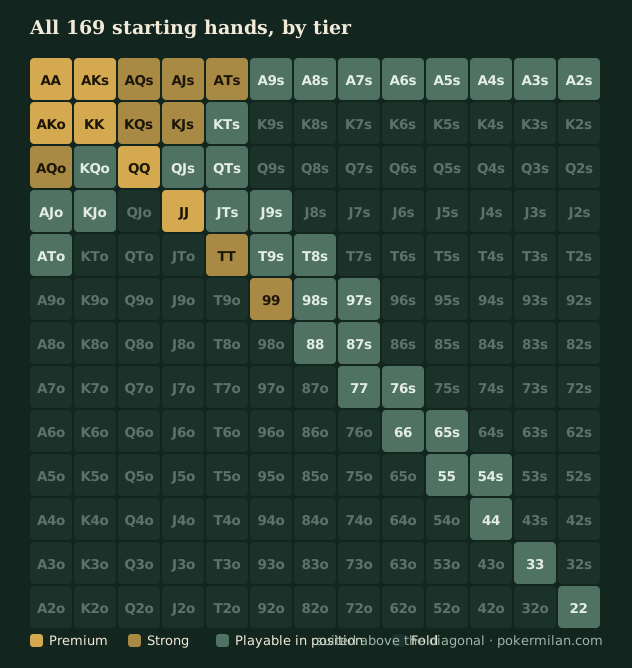
Contrast that with 7-2 suited, which climbs a long way up the grid on the flush defect alone — still a fold, but not the worst hand. The three defects are additive, and every hand in the table above carries at least two of them.
One honest caveat: “worst vs. random” isn’t quite “worst in practice” — hands like 3-2s make more straights than 7-2o but play almost as badly against real raising ranges. Every hand in this table and its neighbors is an always-fold, so the distinction is academic.
The hands that actually cost you money
Nobody goes broke with 7-2o. These are the real bankroll leaks:
1. A-rag offsuit (A2o–A8o)
The most expensive category in low-stakes poker. You flop your ace, bet, get called — and lose to a better kicker. A weak ace’s winning scenario is a small pot; its losing scenario is a big one. That asymmetry compounds forever.
Walk one through. Blinds are $1/$2, a solid player opens to $8, you call with A♦5♣. Flop is A♠9♥4♣ — the exact flop you were hoping for. Pot $19, he bets $12, you call. Turn 2♦, he bets $30, you call. River K♣, he bets $70.
Now name the hands that bet three streets on that board: AK, AQ, AJ, A9, plus sets. You beat none of them. You beat pure bluffs and hands that would have checked. You have already put in $50 to reach a river where your top pair is almost never good, and the $70 decision is only hard because the first three were easy. This is reverse implied odds in plain view: you were “ahead” on the flop and it cost you anyway.
2. K-J and Q-J offsuit
“Two paint cards!” — which flop top pair and lose to AK, AJ, KQ, and AQ respectively. KJo against a tight raiser is one of the most dominated common situations in the game.
The combinatorics are brutal. Flop K♠7♦3♣ with KJo against a tight early-position raiser: three kings remain, so his king-holdings are roughly 12 combinations of AK and a handful of KQ. Every single one beats you. The king-hands you do beat — KT, K9, K8 — are hands a tight player never opened in the first place. You hold top pair and you are drawing nearly dead against the part of his range that keeps betting.
3. Small suited “somethings” (Q4s, J3s, K6s)
Being suited is worth about 2.5% equity. Players treat it like 25%. You’ll flop a flush 0.8% of the time and a draw 11% — the rest of the time you own a bad kicker and a prayer.
Even the 11% is oversold. A flush draw with the Q♦ high is not the nut draw; when the fourth diamond lands and money goes in, you are often paying off a bigger flush. Discount non-nut draws before you price them — the counting method is in poker hand probabilities.
4. Baby pairs played from any position for any price
22–55 are profitable set-mining hands: cheap calls, deep stacks, position. Called 3-bets out of position, they’re money furnaces — you flop a set once in 8.5 tries and an underpair to the board the rest.
The break-even test is one line. Call $15 hoping to flop a set 11.8% of the time:
0.118 × X ≥ 0.882 × $15 → X ≈ $112
You need to win roughly 7.5× your call on the hands you hit. Against a 3-bet that leaves $60 behind, that money does not exist, so the call is a straight loser regardless of how well you play the flop. More on getting this right in the pocket pairs guide.
The two kinds of bad hand
| Obvious trash (7-2o) | Trap hands (A5o, KJo, Q4s) | |
|---|---|---|
| How often you enter a pot with it | Almost never | Regularly |
| Flops that feel like a hit | Effectively none | Top pair, weak kicker |
| Pot size when you win | Small | Small |
| Pot size when you lose | Small — you already folded | Large |
| Lifetime cost | Near zero | The biggest leak at low stakes |
The table explains the whole paradox. A hand’s cost is equity × how often you play it × how big the pots get. 7-2o scores terribly on the first term and zero on the second, so it costs nothing. A5o scores acceptably on the first and badly on the third — and the third term is where money actually lives.
Why “any two can win” is technically true and financially ruinous
Yes, 7-2o wins about a third of showdowns against one random hand. But poker isn’t showdown-vs-random — it’s contested pots against selected ranges, with betting on four streets. Weak hands don’t just win less often; they win small pots and lose big ones, because when they connect, better versions of the same hand connect harder. Equity decides all-ins; reverse implied odds decide everything else.
There’s a second layer. That 34% figure assumes the hand goes to showdown for free. In a real pot you must survive three betting rounds without ever knowing whether your pair is good — and being out of position multiplies that uncertainty, which is the whole argument in position in poker.
Three mistakes and their fixes
Playing an ace because it’s an ace. The card is a rank, not a license. Fix: require a kicker of ten or better, or a suit plus position. If you’d fold the same hand without the ace, you’re playing the ace alone.
Calling one more street to “see what happens.” Every trap-hand disaster is built from three calls that each felt small. Fix: on the flop, decide what you do on a turn bet and a river bet. If the honest answer is “fold,” fold now and keep the $42.
Confusing pretty with playable. Suited, connected, paint — none of these survive contact with a raising range. Fix: judge a hand by what it looks like when it hits. If your best realistic flop is second-best top pair, the hand is in the fold tier. Knowing when to fold is a skill, not a temperament.
FAQ
Is 7-2 offsuit really the worst hand in Hold’em? By equity against a random hand, yes — around 34%, the lowest of all 169. It’s the lowest hand whose two cards can’t appear in the same straight, it can’t make a flush, and its best pair loses to ten of the thirteen ranks.
Should I ever play 7-2 offsuit? Only when it’s free. In the big blind with no raise, you already have the option and folding gains nothing. Beyond that: it is a fold from every seat, at every stack depth, for any price.
Which hand costs the average player the most money? Weak offsuit aces, by a wide margin. They get played far too often, they flop top pair often enough to feel justified, and top pair with a bad kicker is precisely the hand that wins small pots and loses stacks.
Does being suited rescue a bad hand? No. Suitedness adds about 2.5% equity — real, but small. It moves a marginal hand slightly up the grid; it never moves a fold into a raise. Check any of these against the best starting hands grid and the ordering barely shifts.
The discipline dividend
Folding trash isn’t a defensive habit; it’s where winrate comes from. Every junk hand folded preflop is a hand where your opponents can make mistakes and you can’t. Combine a real opening standard — see the preflop chart — with an honest list of your personal “trap hands,” and you’ve fixed the biggest leak most players ever have. For what to play instead, start with the best starting hands guide.
Discipline works the same way away from the felt: decide your limits before you sit, and treat them as fixed. The responsible gaming page covers how to set them.
Keep learning: try the free poker odds calculator, memorize the hand rankings, or browse all strategy guides.