Best Starting Hands in Texas Hold'em, Ranked
There are 1,326 possible two-card combinations in Texas Hold’em, but only 169 strategically distinct starting hands: 13 pocket pairs, 78 suited hands, and 78 offsuit hands. Most of them are unprofitable most of the time. This guide ranks the ones that matter and — more importantly — explains why they rank where they do, so you can judge the borderline cases yourself.
The reduction from 1,326 to 169 is worth understanding, because it tells you what to store in memory. A♠K♠ and A♥K♥ play identically, so both collapse into “AKs.” Every pocket pair has 6 combinations, every suited hand 4, every offsuit hand 12. That 6 / 4 / 12 split explains why offsuit hands dominate the deals you actually see, and why most of them belong in the muck.
How the 169 hands break down
| Tier | Roughly how many hands | What it wants | Default action |
|---|---|---|---|
| Premium | 5 | A raised, heads-up pot | Raise and re-raise from any seat |
| Strong | ~10 | A raised pot, few opponents | Raise; fold to heavy pressure |
| Playable | ~35 | Position, or a cheap multiway pot | Open late, fold early |
| Fold | ~120 | Nothing you can give it | Muck, every seat, every time |
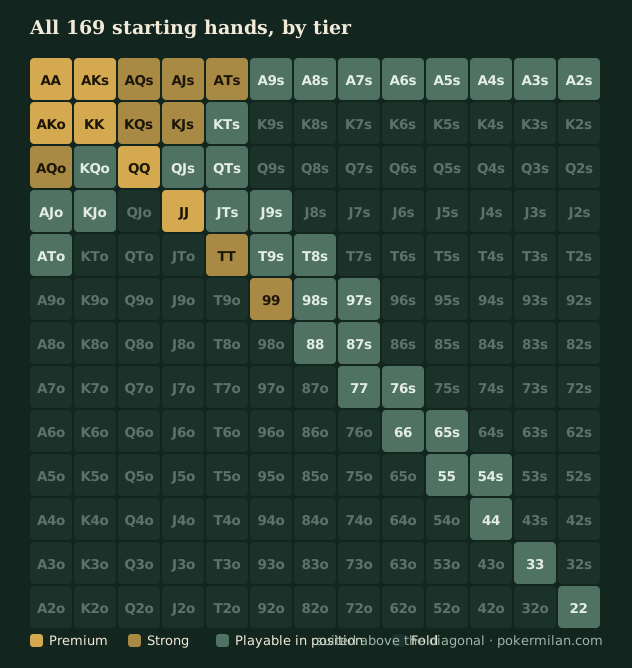
Two-thirds of the grid is a fold before position even enters the conversation. That is the single most important fact on this page.
The premium five
These hands are profitable from every seat at the table.
| Hand | Nickname | Equity vs. a random hand | Dealt how often? |
|---|---|---|---|
| A♠A♥ | Pocket rockets | ~85% | 1 in 221 |
| K♠K♥ | Cowboys | ~82% | 1 in 221 |
| Q♠Q♥ | Ladies | ~80% | 1 in 221 |
| A♠K♠ | Big slick (suited) | ~67% | 1 in 332 |
| J♠J♥ | Fishhooks | ~77% | 1 in 221 |
Two things to notice. First, AA is dealt once every 221 hands — about once per session in live play. When it comes, your job is to build a pot, not to trap timidly. Second, AK suited has lower raw equity than JJ but often plays better: it dominates the aces and kings weaker players love to call with, and it makes the nut flush.
That second point deserves a number. Equity against a random hand is the wrong test, because nobody calls a raise with a random hand. Against the range a typical player continues with — big aces, big broadways, pairs — JJ is frequently racing or behind, while AK is either flipping or crushing. AA’s 85% also has a tail: it loses about one time in seven heads-up, and considerably more often multiway, which is why “protect the pot with a raise” beats slow-playing.
The strong tier: 99–TT, AQ, AJs, KQs
These hands want a raised, short-handed pot. Tens and nines are real favorites against almost any unpaired hand but hate four-way flops full of overcards. AQ is the classic “good but dominated” hand — it loses big pots to AK and wins small ones from AJ. Raise it, but be able to fold it when a tight player plays back hard.
Domination, in actual numbers
“Dominated” is not a vibe. When AQ runs into AK, AQ wins about 26% of the time. Compare that to 7♠6♠ against the same AK, which wins around 40% despite being a far worse hand in the abstract. The difference is that AQ’s queen is often dead — it pairs and still loses — while the suited connector’s outs are live and disguised.
That single comparison rewrites how you should think about calling a tight player’s raise:
| Your hand vs. a tight UTG raiser | Why it goes wrong |
|---|---|
| A♥Q♦ | Beaten by AK, flips with pairs, only beats hands that fold |
| K♦J♠ | Makes second-best top pair against AK, KQ, AJ |
| A♦5♦ | Top pair with a kicker that cannot win a big pot |
| 7♠6♠ | Loses small, wins big — the only one that plays fine |
The lesson: hand strength is relative to the range you are up against, not to the 169-hand grid. A hand that can only be good when it is beaten is a fold, and knowing when to fold is what separates break-even players from winning ones.
The situational tier: suited connectors and small pairs
Hands like 8♠7♠, 6♥5♥, and pocket deuces through sixes share one trait: they miss most flops but win big when they hit.
- A pocket pair flops a set about 11.8% of the time — once in 8.5 tries. When it does, it’s nearly invisible and gets paid by big pairs and top pair.
- Suited connectors flop a flush draw, straight draw, or better often enough to keep playing aggressively in position.
The rule for this tier is simple: cheap and multiway, or in position — otherwise fold. Calling big 3-bets out of position with 5♦4♦ is how sessions die.
The set-mining math, step by step
Say a player opens to $15 and you hold 5♠5♦. You call $15, so the pot is around $36. You flop a set 11.8% of the time and, realistically, you win nothing the other 88.2%.
Break-even: 0.118 × X ≥ 0.882 × $15 → X ≈ $112
You need to average about $112 when you hit — roughly 7.5 times your call — for the call to be neutral. Two conditions follow directly. Effective stacks must be deep enough to hold that money (call it 15–20× the call, since you won’t get paid every time), and your opponent must be the type who pays off. Call $15 with $60 behind and the math cannot work no matter how well you play the flop. Full detail on both sides of that equation lives in pot odds explained and the pocket pairs guide.
Overrated hands that cost players money
- KJo, QJo, KTo — “broadway junk.” They make second-best top pairs that lose to AK/AQ/KQ. Fine to open when folded to you in late position; bad calls against raises.
- Small offsuit aces (A2o–A8o) — a weak ace’s most common strong flop is top pair, terrible kicker. You win a small pot or lose a big one.
- Any two suited — being suited adds only about 2.5% equity on average. J3s is not a hand; it’s a decoration.
Put the suited premium in perspective: AK suited is worth roughly 2.5 points more than AK offsuit, and that is the entire value of matching suits. It converts a marginal hand into a slightly less marginal hand. It never converts a fold into a raise. The genuinely unplayable holdings — and why they stay unplayable — are covered in worst hands in poker.
The three factors that decide a hand’s value
- Position. The button profitably plays roughly three times as many hands as UTG. The same 9♠8♠ is a snap-open on the button and a fold under the gun. Our preflop chart maps this precisely.
- What kind of pot it’s going into. Big pairs want raised heads-up pots; small pairs and suited connectors want cheap multiway pots. If the action in front of you creates the wrong kind of pot for your hand, fold.
- Domination risk. Ask “when I make my hand, who pays me — and when someone plays back, what beats me?” AQ vs. a tight UTG raiser is dominated; 7♠6♠ vs. the same raiser at least has live, disguised outs.
What “position triples your range” actually means
Under the gun at a six-handed table you open about 15% of hands, because five players still get to act behind you. On the button you open about 44%, because only the blinds remain and you act last on every street that follows. Same 169 hands, same deck, three times the range — the only variable is how much information you’ll have when the money goes in.
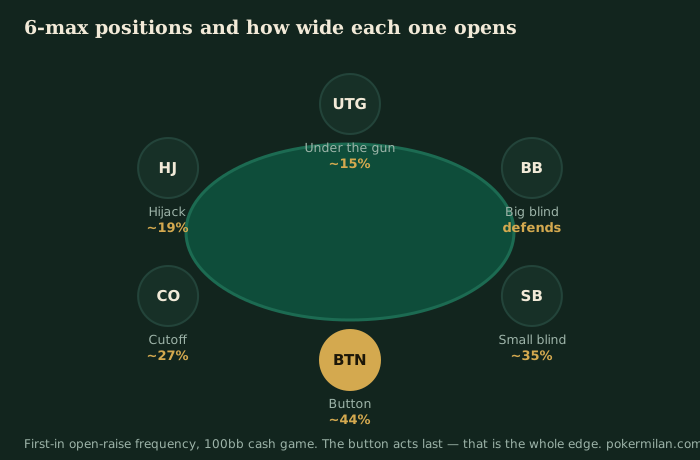
This is why a starting-hand chart with no position column is close to useless. The correct question is never “is 9♠8♠ a good hand?” but “is 9♠8♠ a good hand here?” The reasoning behind the seat-by-seat widening is laid out in position in poker.
Quick reference: dealt-odds worth memorizing
- Any pocket pair: 5.9% (1 in 17)
- Two suited cards: 23.5% — but see above, suits alone don’t make a hand
- AK (any): 1.2% (1 in 82)
- AA or KK: 0.9% (1 in 110)
These come straight from combination counting; the arithmetic behind them is in poker hand probabilities.
Three mistakes and their fixes
Playing a hand because it’s “pretty.” Suited kings, connected paint, one-gap suited aces. Fix: before you enter a pot, name the flop you’re hoping for and ask who else would be in the hand on that flop. If the answer is “someone with a better version of my hand,” fold.
Calling raises instead of making them. Cold-calling with KJo or A9s gives you no fold equity and a range full of second-best hands. Fix: if a hand isn’t strong enough to raise or 3-bet, it usually isn’t strong enough to call.
Widening in early position because you’re bored. The 15% UTG range exists because five players act after you, not because the chart’s author is conservative. Fix: if you’re folding too much to enjoy the game, move to a shorter-handed table where the button comes around faster.
FAQ
Is AK better than QQ? Against a random hand, QQ wins about 80% and AK suited about 67%, so QQ is the stronger holding. All-in preflop between them is close to a coin flip. QQ is worth more; AK is easier to play after the flop because you always know where you stand when you hit.
Should I ever fold pocket aces preflop? Essentially never — it’s the best hand you can hold with 85% equity against a random hand. There are rare tournament spots where survival value changes the calculation, but in a cash game, raise and re-raise.
How many starting hands should I actually play? Across all seats combined, a solid six-max player voluntarily enters roughly a quarter of pots. That average hides a huge spread: about 15% under the gun and about 44% on the button.
Do suited connectors beat big offsuit cards? Head to head, usually not by much — 7♠6♠ takes around 40% against AK. But they lose small pots and win big ones, which is the opposite of KJo. Expected value comes from the size of the pots you win, not the frequency.
The bottom line
Premium pairs and AK play themselves preflop — raise. The middle tier is a position question. The bottom 60% of hands is a fold, and folding it immediately is the single biggest winrate improvement available to most players. To see the exact open-raising range for each seat, use the 6-max preflop chart; to test any matchup yourself, run it through the free odds calculator.
Keep learning: try the free poker odds calculator, memorize the hand rankings, or browse all strategy guides.