Poker Hand Probabilities Explained From Scratch
Every “poker odds” number you’ve ever seen comes from one piece of arithmetic: counting combinations. This guide builds the whole thing from scratch — no formulas beyond multiplication and division — and then turns it into the practical Hold’em numbers you’ll actually use mid-hand.
The master number: 2,598,960
How many distinct five-card hands exist in a 52-card deck? Choose 5 from 52 where order doesn’t matter:
52 × 51 × 50 × 49 × 48 ÷ (5 × 4 × 3 × 2 × 1) = 2,598,960
The top line, 311,875,200, counts ordered deals — first card, second card, and so on. But A♠K♠Q♠J♠T♠ is the same hand however it arrives, and five cards can be arranged 5 × 4 × 3 × 2 × 1 = 120 ways. Dividing by 120 collapses those duplicates and leaves 2,598,960 genuinely different hands.
Every five-card probability is just (ways to make the hand) ÷ 2,598,960. That one denominator is the whole foundation. Learn to count numerators and you never need to memorize a chart again.
Counting each hand
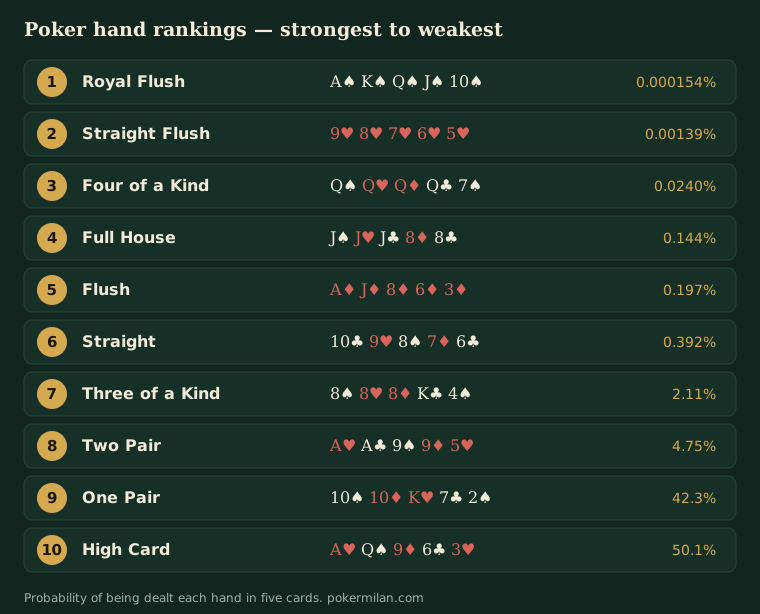
- Royal flush: one per suit → 4 combinations (0.000154%).
- Straight flush: 10 possible high cards per suit minus the royal → 9 × 4 = 36 (0.00139%).
- Four of a kind: 13 ranks for the quads × 48 remaining cards for the kicker = 624 (0.024%).
- Full house: 13 ranks × 4 ways to pick 3-of-4 cards, times 12 ranks × 6 ways to pick the pair = 13×4×12×6 = 3,744 (0.144%).
- Flush: 1,287 five-card suit combos × 4 suits, minus the 40 straight flushes = 5,108 (0.197%).
- Straight: 10 high cards × 4⁵ suit assignments, minus 40 straight flushes = 10,200 (0.392%).
- Three of a kind: 13×4 trips × 66 kicker-rank pairs × 16 suit combos = 54,912 (2.11%).
- Two pair: 78 rank pairs × 6 × 6 suit choices × 44 kickers = 123,552 (4.75%).
- One pair: 1,098,240 (42.3%) — the most common made hand.
- High card: everything else — 1,302,540 (50.1%).
Add those ten counts and you get 2,598,960 exactly. Nothing is left over, because every possible five-card hand is one — and only one — of these ten categories. That closure is the proof your arithmetic is right.
| Hand | Combinations | Probability | Roughly |
|---|---|---|---|
| Royal flush | 4 | 0.000154% | 1 in 649,740 |
| Straight flush | 36 | 0.00139% | 1 in 72,193 |
| Four of a kind | 624 | 0.0240% | 1 in 4,165 |
| Full house | 3,744 | 0.144% | 1 in 694 |
| Flush | 5,108 | 0.197% | 1 in 509 |
| Straight | 10,200 | 0.392% | 1 in 255 |
| Three of a kind | 54,912 | 2.11% | 1 in 47 |
| Two pair | 123,552 | 4.75% | 1 in 21 |
| One pair | 1,098,240 | 42.3% | 1 in 2.4 |
| High card | 1,302,540 | 50.1% | 1 in 2.0 |
Two counts worked end to end
Full house. Pick the rank you hold three of: 13 choices. Pick which three of that rank’s four suits: 4 ways (you leave one out). Pick a different rank for the pair: 12 choices. Pick two of its four suits: 6 ways. Multiply: 13 × 4 × 12 × 6 = 3,744. The order matters here — “kings full of twos” and “twos full of kings” are separate hands, which is why it’s 13 × 12 and not 78 rank pairs.
One pair. Pick the paired rank: 13. Pick two of its suits: 6. Now pick three kicker ranks from the remaining 12, all different so you don’t accidentally build two pair or trips: 220 ways. Each kicker can be any of 4 suits: 4 × 4 × 4 = 64. Multiply: 13 × 6 × 220 × 64 = 1,098,240. The kicker block is where most of the size comes from, and it’s also why kickers decide so many real pots.
Why the ranking order is the rarity order
Notice the ranking order is the rarity order — that’s the entire logic of the hand rankings. Nobody sat down and decided a flush should beat a straight for aesthetic reasons; there are 5,108 flushes and 10,200 straights, so the flush is twice as hard to make and ranks higher. If you have ever wondered whether a flush beats a straight, the combination counts are the answer, not tradition.
The extremes make the point: the royal flush (4 hands) and the straight flush (36) share 40 combinations between them, while the bottom two categories share 2.4 million.
From five cards to Hold’em: outs
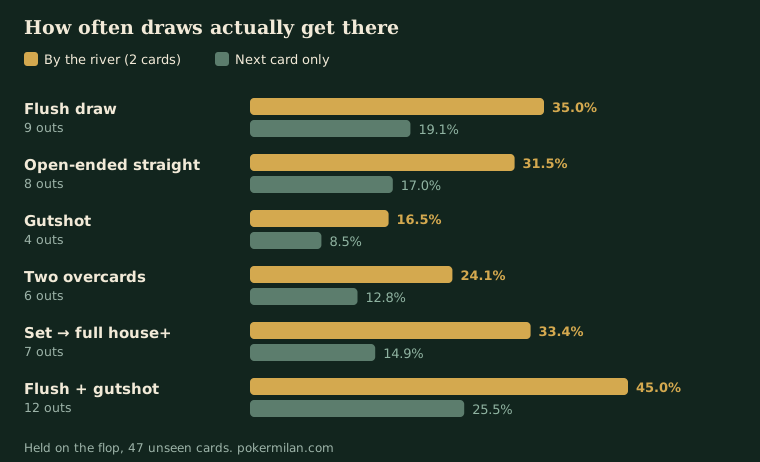
In Hold’em you don’t get five random cards; you improve across streets. The working unit is the out — an unseen card that completes your hand. With your 2 cards and a 3-card flop visible, 47 cards are unseen; each out is worth 1/47 ≈ 2.1% per card to come.
| Draw on the flop | Outs | Hit by river | Hit on next card |
|---|---|---|---|
| Flush draw | 9 | 35.0% | 19.1% |
| Open-ended straight draw | 8 | 31.5% | 17.0% |
| Gutshot (inside straight) | 4 | 16.5% | 8.5% |
| Two overcards | 6 | 24.1% | 12.8% |
| Set → full house/quads | 7 | 33.4% | 14.9% |
| Flush draw + gutshot | 12 | 45.0% | 25.5% |
Counting outs on a real board
You hold J♠T♠. The flop comes 9♠8♦2♠. Count deliberately, one category at a time:
- Flush outs: 13 spades exist, you can see four (J♠, T♠, 9♠, 2♠). 9 left.
- Straight outs: any queen or seven completes Q-J-T-9-8 or J-T-9-8-7. That’s 4 + 4 = 8 cards — but Q♠ and 7♠ are already counted as flush outs. 6 new.
- Total: 15 outs. By the river that’s about 54% — with two cards to come you are a favorite over top pair.
The overlap check is the step people skip. Count a shared card once, never twice, or you will talk yourself into calls you cannot afford.
The rule of 4 and 2
The only mental math you need at the table:
Flop (two cards to come): outs × 4 ≈ your %. Turn (one card): outs × 2.
Nine-out flush draw on the flop: 9 × 4 = 36% (true value 35.0%). On the turn: 9 × 2 = 18% (true 19.6%). The rule overshoots slightly above 10 outs; subtract a point or two there and you’re within rounding error of exact.
The rule works because one out is worth about 2% per card, so two cards to come is about 4% per out. It drifts high on the flop because the two draws overlap — you can’t hit the same out twice, and the ×4 version quietly double-counts rivers you never see.
| Outs | Rule of 4 says | True (by river) | Error |
|---|---|---|---|
| 4 (gutshot) | 16% | 16.5% | −0.5 |
| 6 (two overcards) | 24% | 24.1% | −0.1 |
| 8 (open-ender) | 32% | 31.5% | +0.5 |
| 9 (flush draw) | 36% | 35.0% | +1.0 |
| 12 (draw + gutshot) | 48% | 45.0% | +3.0 |
One exception runs the other way. A set improving to a full house or quads is listed at 7 outs but hits 33.4% of the time, well above the 28% the rule predicts, because a turn card that pairs the board creates new outs for the river. Any time your outs can multiply on later streets, the rule understates you.
An estimate is only half a decision. The other half is pot odds: the price you’re being offered has to be lower than the equity you just counted.
Preflop numbers that shape strategy
- Pocket pair flops a set: 11.8%. This single number justifies “set mining” — calling small raises with small pairs when stacks are deep enough to win 8–10× your call.
- Suited cards flop a flush draw: ~11% (and a made flush just 0.8%). Suits are worth ~2.5% equity, not a reason to play bad cards.
- AK hits an ace or king on the flop: ~32.4% — two sessions in three, big slick whiffs the flop. Plan for it.
- Pair vs. two overcards (“coin flip”): ~55/45. Pair vs. one overcard: ~70/30. Dominated ace (AQ vs AK): ~26/74. These three matchups cover most all-in situations you’ll ever face.
The dealing frequencies come from the same counting method, using C(52,2) = 1,326 two-card starting combinations instead of 2,598,960:
| Starting hand | Combos | Frequency |
|---|---|---|
| A specific pair (e.g. AA) | 6 | 1 in 221 |
| Any pocket pair | 78 | 1 in 17 |
| A specific suited hand (e.g. AKs) | 4 | 1 in 332 |
| A specific offsuit hand (e.g. AKo) | 12 | 1 in 111 |
| Any two suited cards | 312 | 1 in 4.25 |
Two things follow. Aces arrive roughly once every three hours of live play, so a strategy built on waiting for them is a strategy built on folding. And suited hands turn up nearly one deal in four, so “it was suited” can never be the reason you entered a pot — see the pocket pairs guide for what actually justifies putting money in with a small pair.
At the top of the range, AA wins about 85% heads-up against a random hand and AK suited about 67%. Strong, but not safe — aces lose roughly one time in seven.
Three mistakes the numbers fix
Counting outs that aren’t clean. You hold 6♠4♠ on K♠9♠3♦ and count nine flush outs. Against A♠J♠, several of those “outs” hand you the second-best flush and a very expensive river. Fix: ask what the draw looks like when it hits, then discount non-nut draws to six or seven effective outs.
Using ×4 when you’ll only see one card. The rule of 4 assumes both remaining cards are free. If your opponent bets again on the turn, you paid flop price for one card, not two. Fix: use ×2 on the flop unless the bet puts someone all-in.
Treating rare hands as reachable. Quads arrive once in 4,165 five-card hands. Fix: build decisions around the 42.3% and 4.75% categories — one pair and two pair win most real pots, and deserve far more of your study time than a royal flush ever will.
FAQ
Why is a flush ranked above a straight if flushes feel more common? They feel common because two suited cards make a flush draw often, but drawing is not making. Across all five-card hands there are 5,108 flushes and 10,200 straights — the straight is exactly twice as likely, so it ranks lower.
Do these probabilities change in Texas Hold’em? The five-card counts describe a random five-card deal. In Hold’em you see seven cards and pick the best five, so made hand frequencies rise sharply — two pair or better is routine by the river. The rankings don’t change, because the relative rarity order is preserved.
Does the rule of 4 and 2 work with very big draws? Poorly. Above about 12 outs the ×4 shortcut overshoots by three points or more, and by 15 outs it is badly optimistic. Use ×3 for monster draws, or check the exact number in the odds calculator.
How many outs do I need to call a half-pot bet? A half-pot bet needs 25% equity. On the turn with one card to come that’s about 12 outs; on the flop with two to come, about 6–7. Anything less is a fold unless implied odds are genuinely large.
Putting it together
Probability tells you your equity; pot odds tell you whether the price is right (need pot-odds% < equity%); position and reads fill in the rest. Practice converting situations to numbers with the free odds calculator — a few dozen runs and the common spots become automatic.
One last thing the math is honest about: variance is real, and no probability on this page promises a result on any given night. Set limits before you sit and read the responsible gaming page — good math and good habits are the same discipline.
Keep learning: try the free poker odds calculator, memorize the hand rankings, or browse all strategy guides.