Seven Card Stud: Rules and Starting Strategy
Before Hold’em conquered the world, Seven Card Stud was poker in America. It remains the best training ground for two skills Hold’em lets you neglect: tracking dead cards and reading hands from exposed boards. Here’s the full game, structure first.
The structure
Stud is played fixed-limit, traditionally 8 players max, with no community cards. In a $2/$4 game:
- Ante. Everyone posts a small ante (say $0.25) before the deal.
- Third street. Each player gets two cards down, one up. The lowest exposed card must “bring in” for a token amount (suit breaks ties: clubs, diamonds, hearts, spades). Action then proceeds in $2 units.
- Fourth street. Another up card. Highest exposed board acts first — still $2 bets (except: an open pair may bet $4).
- Fifth street. Third up card. Bets double to $4 from here on.
- Sixth street. Fourth up card, $4 bets.
- Seventh street (“the river”). Final card, dealt face down. Last $4 round, then showdown — best five of your seven cards wins.
Note the rhythm: by fifth street each player shows three cards, and the bets double. Fifth street is the decision point of the whole game — continuing past it should mean you intend to see the river.
The streets at a glance
| Street | Cards you hold | New card | Bet size | Acts first |
|---|---|---|---|---|
| Third | 3 (2 down, 1 up) | door card | $2 (bring-in $1) | Lowest up card |
| Fourth | 4 | up | $2, or $4 with an open pair | Highest board |
| Fifth | 5 | up | $4 | Highest board |
| Sixth | 6 | up | $4 | Highest board |
| Seventh | 7 | down | $4 | Highest board |
Four bets per street is the standard cap — a bet plus three raises — which is what makes fixed-limit stud a game of accumulated small edges rather than one-decision-for-everything.
Why the lowest card brings in
The bring-in exists to guarantee action, so it falls on the player least likely to want any: the worst door card at the table. If two players show the same rank, suit order decides, and stud uses the bridge order — clubs lowest, then diamonds, hearts, spades. This is one of the few places in poker where suits have any ranking at all; in almost every other context they are equal, as the poker suits guide explains. The bring-in player may post the token amount or “complete” straight to the full small bet.
The deck really can run out
Eight players who all reach seventh street would need 56 cards from a 52-card deck. It almost never happens, but the rule is fixed: when the stub cannot cover everyone, the dealer turns one community card face up in the centre and every remaining player uses it as their seventh card.
Hand rankings still apply
Stud uses the ordinary five-card rankings — you simply choose the best five of your seven. There are no shared cards, so the underlying frequencies are the familiar ones.
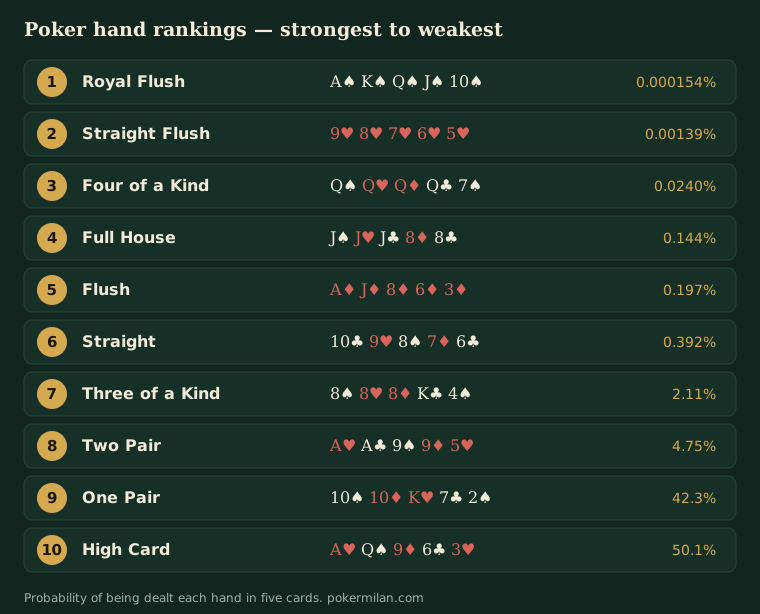
Because you see seven cards instead of five, made hands arrive far more often than the raw numbers suggest. A flush is only 0.197% of random five-card hands, but a three-flush on third street gets there roughly 18% of the time when the suit is completely live. That gap between “how rare is the hand” and “how likely am I to reach it” is the whole game — the full rankings are the reference, the drawing numbers below are what you use.
Starting hands: third street standards
You see three of your own cards and one card from every opponent immediately. Both halves matter.
Premium (raise):
- Rolled-up trips (three of a kind dealt) — about 1 in 425 deals; play them fast or slow, but count yourself lucky
- Big pairs (TT+), especially with the pair hidden (“wired”) — disguise is worth real money in stud
- Three big suited cards (e.g., A♠K♠J♠)
Playable (call, position and cards permitting):
- Medium pairs with a big kicker and live cards (see below)
- Three-straights or three-flushes with high cards — e.g., J-10-9 or three to a flush with two overcards
Fold: small split pairs with dead kickers, unconnected junk with one big card, and any drawing hand whose key cards are visibly gone.
How often you actually get these
There are C(52,3) = 22,100 three-card starting hands. That fixes the frequencies precisely:
| Third street holding | Chance | Roughly |
|---|---|---|
| Rolled-up trips | 0.24% | 1 in 425 |
| Wired pair (both cards down) | 5.65% | 1 in 18 |
| Split pair (one hole card matches your door card) | 11.3% | 1 in 9 |
| Three to a flush | 5.18% | 1 in 19 |
| No pair, no three-flush | ~78% | 4 in 5 |
Nearly four hands in five are junk on third street. Folding them is not tightness, it is arithmetic — and it is why a stud table that plays 25% of hands prints money for the two players who play 15%.
Wired beats split. Both are one pair, but the wired version hides its strength: your door card looks like a random low card, so opponents keep paying you on later streets. The split pair announces itself the moment you pair the door card on fourth street. Same hand, different money.
“Live” is everything
A hand’s value in stud depends on the exposed cards around you. Holding 9♥9♣/K♦? If a 9 and two kings are showing in opponents’ boards, your hand is a mirage — two of your five improvement cards are gone. That flush draw worth playing at a table showing zero of your suit is a fold when four are out.
Discipline rule: count your key cards on third street, and keep counting. Strong stud players can name every folded up-card by seventh street. Start smaller: just track your own outs and the ranks that beat you.
Worked example: the same flush draw, twice
You hold A♠ 9♠ / 4♠ on third street — three spades, ace high.
Table A, no spades showing. Ten spades remain among 49 unseen cards. You need at least two of them across your four remaining cards. Running the combinations: of the 211,876 four-card runouts, 38,235 contain two or more spades. That is 18.1% — a hand worth a call, and worth a raise if the ace also plays.
Table B, four spades showing in opponents’ boards. Now six spades remain among 42 unseen. The same calculation gives 9.1%. Your equity did not drift; it halved, before a single further card was dealt.
Nothing about your cards changed. Everything about their value did. That is card removal, and it is the single mechanic that separates stud from Hold’em, where you never see an opponent’s card until showdown. Run the equivalent Hold’em numbers on the odds calculator and you will see how much information stud hands you for free.
Street-by-street strategy
- Third street: tight and aggressive. Raising thins the field — big pairs play far better against one caller than four.
- Fourth street: if an opponent pairs their door card (their first up card), beware — the most likely holding is trips. This is stud’s loudest tell.
- Fifth street: the pivot. Bets double; pot odds you offer draws shrink. Bet made hands hard, and fold marginal draws that didn’t improve — calling “one more” here usually commits you to the river.
- Sixth and seventh: mostly automatic if fifth street was played correctly. On the end, call with any hand that beats a busted draw if the pot is large — the pot odds in limit almost always justify the “crying call.”
Why fifth street is the pivot, in numbers
Say the pot holds $24 on fifth street and it is $4 to you with a live four-flush — nine outs, two cards to come, roughly 30% to get there. You are getting 7-to-1 on a call that needs about 2.3-to-1. Easy call.
Now the same draw with only five live cards because four of your suit are dead: about 17% to improve, needing roughly 4.9-to-1. The pot still lays 7-to-1, so it is still a call — but add one raise behind you and it is not. This is why the pot odds framework has to be recomputed on every street in stud: your outs move as cards appear, and the bet size doubles halfway through.
Common mistakes and the fix
| Mistake | Why it costs | Fix |
|---|---|---|
| Playing three-flushes with dead suits | 18% becomes 9% — the hand stops paying for itself | Count your suit before calling the bring-in |
| Calling third street with a small split pair | Behind every bigger pair, and the pair is visible | Fold unless the kicker is live and big |
| Chasing past fifth street “for one more card” | Bets doubled; one more card is really three more bets | Decide on fifth street whether you are going to the river |
| Ignoring an opponent who pairs their door card | Trips is the most likely holding, and you are drawing near dead | Fold marginal hands immediately |
| Slow-playing rolled-up trips every time | You win a tiny pot with the best hand in the game | Bet third street often; the disguise survives the raise |
| Folding the river to a single bet in a big pot | In fixed-limit the pot usually lays 10-to-1 or better | Make the crying call with any hand that beats a busted draw |
How stud differs from Hold’em thinking
- No shared cards — your full house never splits with someone playing the same board. Hand values are absolute.
- Information accumulates publicly. Memory substitutes for position (which changes street to street, following the high board).
- Fixed-limit math dominates. With small bets relative to the pot, correct play is mostly disciplined counting — the hand probabilities toolkit applies directly, with the twist that dead cards constantly adjust your outs.
Point two deserves emphasis. In Hold’em the button acts last on every street and you can plan around it. In stud the order is set by the highest exposed board and can change three times in one hand. You do not get to buy position; you earn it by having the scarier board, which is a different — and in some ways more honest — version of the same advantage covered in position in poker.
FAQ
What are the odds of being dealt rolled-up trips? 52 of the 22,100 possible three-card starts are trips, or 1 in 425 — about 0.24%. Expect one roughly every eight hours at a full table. Because it is so rare, opponents rarely put you on it, which is exactly why betting it early loses less value than most players fear.
Do suits matter in Seven Card Stud? Only for two administrative decisions: who brings in on third street and who acts first when two exposed boards tie. Clubs are lowest, then diamonds, hearts, spades. Suits never break ties at showdown — identical hands split the pot.
Can you play Seven Card Stud no-limit? It exists, but the game was built for fixed-limit and almost all serious play is limit. The exposed cards make hand-reading precise enough that no-limit stud turns into a series of near-mechanical shoves; the doubled-bet structure is what keeps drawing hands correctly priced across five streets.
How is it different from five-card stud? Five-card stud deals one down and four up with no seventh-street privacy, so almost your entire hand is public and pairs win most pots. Seven-card gives you three hidden cards and two extra draws, which is why flushes and full houses become live threats. The full comparison is in five-card stud rules.
Stud rewards exactly one habit above all: paying attention when you’re not in the hand. Bring that habit back to any poker variant and it pays for itself.
Keep learning: try the free poker odds calculator, memorize the hand rankings, or browse all strategy guides.